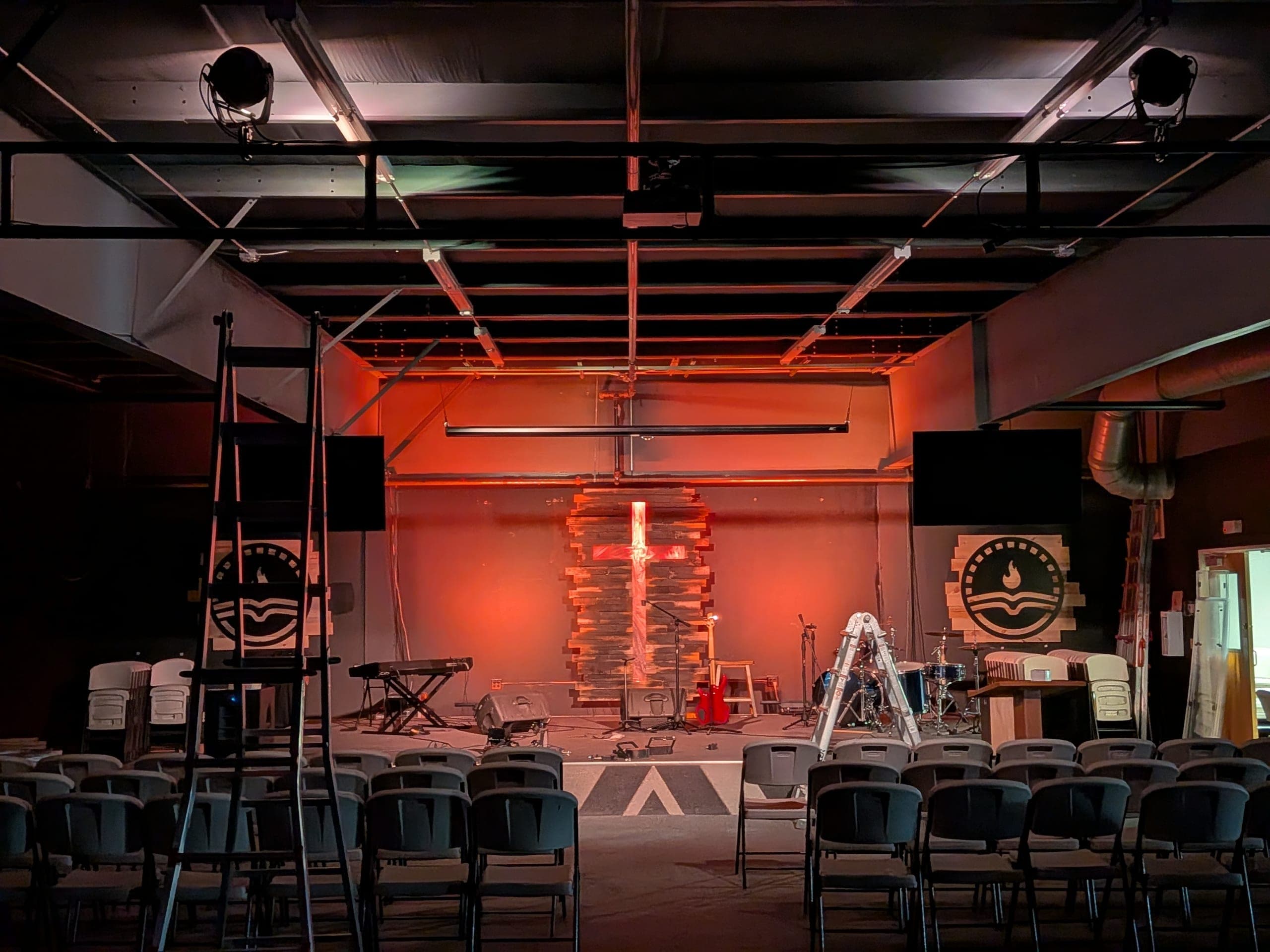
Uplighting is the lighting question we hear most, and the honest answer is that some rooms need a lot of it, some need a little, and a few don't need any. Which one you have depends on your walls, your ceiling, and what time the sun goes down on your date. Here's how we think it through.
What does uplighting actually do?
Uplighting is a row of small fixtures set on the floor against the walls and aimed upward, so a wash of color climbs each wall toward the ceiling. It replaces the flat overhead light most rooms come with, gives the whole space one tone, and makes the room feel finished once the sun is down.
It's worth separating it from the other lighting layers. Uplighting sets the tone of the room. Dance floor lighting moves with the music and lives over the dancing, not the dinner tables. Pin spots are narrow beams on the cake, the head table, or centerpieces, mostly so those things show up in your photos. Monogram projection puts your names or a custom design on a wall or the floor. You can have any of these without the others.
Which venues benefit most from uplighting?
Flat, evenly lit rooms benefit the most, and so do spaces that go dark once the sun sets. A painted ballroom with cream drywall glows with a modest number of lights. A venue with good architectural lighting and warm fixtures of its own often needs only a few accents, and we'll tell you if that's the case.
Uplighting depends entirely on the surface it hits, so the material of your walls matters more than the size of your room. Here's how the common Black Hills venue types tend to behave:
- White or cream ballroom. The easiest room to light. Painted drywall reflects color back into the room, so a dozen lights can make the whole space glow. It's also the room that looks most unfinished without it.
- Wood barn. Bare wood soaks color up instead of bouncing it, so it takes roughly twice as many lights spaced half as far apart to get the same effect. The same square footage that looks great with twelve in a ballroom can take twenty in a barn and still look subtle. The upside is that lit timber looks fantastic.
- Brick, stone, and lodge interiors. These take color beautifully but unevenly, with bright spots and shadows following the texture. That's usually a feature. We'd rather light original brick in Deadwood or the stonework in a lodge than wash the nearest flat wall.
- Tents and outdoor spaces. A white tent wall behaves a lot like painted drywall and takes color well. In the open, there are no walls to light, so the fixtures go on tent poles, trees, or the outside of a building instead, and the plan is more about accents than a full wash.
Season matters too. A June reception in the Black Hills has daylight well past dinner, so your lighting only has a couple of hours to work. An October reception is dark by the time salads come out, and the lighting carries the whole evening.
What color should your uplighting be?
Pick a color that works with the room, not against it. Warm amber and soft white flatter almost every wall and every guest. Wedding colors can usually be matched closely, since LED fixtures mix a huge range, but your walls change the result: the same shade looks different on cream drywall than it does on stone.
Saturated colors like deep blue or purple read strongly and look striking in photos, but anyone standing near a wall picks up that color on their skin, so they're better for the dance than for dinner. Amber and soft white are forgiving and photograph naturally. If one exact shade matters to you, send us photos of your room and we'll test the color against your actual walls before the date.
How does the lighting change from dinner to dancing?
It should change, and it's a single cue. Dinner and toasts get a warmer, softer look so people look good across the table and photos stay natural. When the dance floor opens, the room shifts: the uplights go to your color or a deeper tone, and the dance floor lighting comes up and starts moving with the music.
We build a preset look for each part of the night and run it from DMX control at the booth, so the change happens on time without anyone walking around adjusting fixtures. The dance floor lighting stays over the dance floor on purpose, so it feels like a party where the dancing is and not a nightclub at the tables where your grandparents are finishing dessert. Pin spots usually stay on all night.
What about power and placement?
Power is simpler than people expect. Wireless battery uplights run a full reception on one charge with no cables at all, which is what we use in rooms that don't allow cable runs. For longer events and larger rooms we use wired LED uplights, with cable matting anywhere a cable has to cross a walkway.
No-cable rules are common, especially in historic buildings and park lodges, and they're no problem as long as we know up front. Placement is mostly about spacing fixtures evenly along the walls, tucking them out of walking paths, and aiming them at the surfaces worth seeing. A few things worth finding out from your venue before we talk:
- Whether cables can run across the floor, or whether everything needs to be wireless.
- What the venue's own lights do. Dimmable house lights make uplighting look dramatically better. Fluorescent ceiling panels that can't be turned down fight it all night.
- Where the photos will happen: the cake, the head table, the first dance spot. Those are the places that earn a pin spot.
- Whether the room has anything worth showing off. Timber, brick, a stone fireplace, tall windows. Good lighting brings that out instead of covering it.
What drives the cost of event uplighting?
The number of fixtures, mostly, and that's set by your wall surface and room size far more than any per foot rule. Each extra layer, like dance floor lighting, pin spots, or a monogram, adds gear and setup time. Whether the room needs wireless units and how far your venue sits from Rapid City also factor in.
- Wall material and room size, which together decide the fixture count.
- Whether you want one look for dinner and a different one for the dance, which is a control question more than a gear question.
- Dance floor lighting, pin spots, and monogram projection, each of which is a separate add-on.
- Wireless battery fixtures versus wired, based on your venue's rules.
- Travel to the venue and how early the room has to be set before your guests arrive.
Two rooms of the same size can need very different plans, so send photos of your venue, ideally one taken in the evening with the house lights on, and we'll come back with a real number instead of a range.
The short version
If your room is flat and evenly lit, or goes dark after sunset, uplighting is probably the biggest change you can make to how it feels. If your venue already has warm lighting and something beautiful on the walls, you may only need a few accents, and we'll say so. Either way, the walls decide, and a photo tells us most of what we need to know.
Not sure which kind of room you have? Tell us about your event and send a few photos of the space. We'll tell you what it would take to get the look you want, and if the answer is "not much", we'll tell you that too.