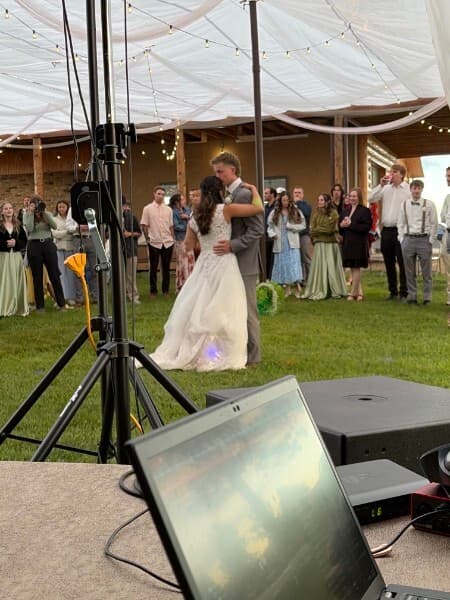
A Black Hills outdoor wedding usually comes down to one scene: the two of you at the front, your guests in rows on the grass or the rock, and a backdrop that did most of the decorating for you. The part that's easy to forget is that the same open space that makes the view also takes your voice away. We've already written about why barn receptions sound the way they do. This is the other half of the day, the ceremony, and it has a completely different set of problems.
Why don't voices carry at an outdoor ceremony?
Voices don't carry outdoors because there's nothing to reflect them. Indoors, walls and ceilings bounce your words back toward the room and add to what people hear directly. Outside, sound spreads in every direction and keeps going. Add a little breeze and the back rows get fragments, not sentences.
This surprises people because the site feels quiet. But a normal speaking voice loses strength fast with distance, and your officiant is facing the two of you, not your guests. Your own voices are quieter still, because nobody projects while saying vows. The front two rows are fine. Row five back is reading lips.
Does a small outdoor wedding need a ceremony sound system?
It depends more on the site than the guest count. Thirty guests in a quiet chapel usually need nothing. Thirty guests on open ground with afternoon wind almost always do, because voices don't carry outside the way people expect. Tell us where you're getting married and we'll give you a straight answer, including "you don't need us."
For a small outdoor ceremony, the system itself is small: one or two compact speakers, a wireless lavalier on your officiant, and a quiet way to play your music. The point isn't volume. It's getting the sound to land on your guests at a level that feels natural, as if they were sitting a few feet from you.
What does wind do to outdoor ceremony audio?
Wind does two things to ceremony audio: it pushes the sound away from your guests, and it blows across the microphones and turns into a low roar. The first is a placement problem. The second is why every microphone we put outdoors wears a wind screen, with no exceptions, even on a calm morning.
Afternoon wind is normal across much of the Black Hills and the prairie around it, which is part of why we want to see your site before the date, or at least your photos and video of it. Which way the wind usually blows tells us which side to favor with the speakers. On open ground we also weight the stands, because a speaker on a stand is a sail.
What if there's no power at your ceremony site?
No outlet is not a problem. We bring a battery powered system that runs your whole ceremony without plugging into anything. Sites with no power are common here, especially state park spots, lake overlooks, and private acreages, so we plan for it ahead of time instead of discovering it on the day.
The honest question we ask is whether there's an outlet within about two hundred feet. If there is, we can run cable and hide it. If there isn't, or if the run would cross your aisle or your photographer's path, battery is the cleaner answer anyway, because there's no cable at all. Around Custer, many ceremony sites sit on state park land, which brings a permit and conditions on amplified sound, vehicle access, and setup time. Battery power is standard there rather than an upgrade, and we build the rules into the plan.
Where do the speakers go, and will they be in the photos?
Speakers go where they can be aimed at your guests and stay out of your photographer's main angles. Those two goals usually agree once we know where the photographer wants to stand. A lavalier on your officiant is nearly invisible in photos, and the rest of the gear is kept small and placed off to the sides.
The best spot for sound is often up front, which is also the one place nobody wants a speaker in the frame. So we talk to your photographer before the date and work around the angles that matter most. Here's what goes into that conversation:
- Where your guests will actually sit, including any overflow at the back or the sides.
- Where the photographer and videographer will stand during the vows, the kiss, and the recessional.
- Where the sun will be, since a speaker against a bright sky stands out more than one against trees or rock.
- Whether the two of you need a second microphone, and if so, where it can sit without showing.
- What you care about more: perfectly captured vows, or no visible equipment at all. Either is fine, and we'll set up to match.
A second microphone for the two of you is a judgment call. In sheltered spots the officiant's lavalier picks up your voices well enough. On open ground, with wind and a few feet of distance, it often doesn't, and a small discreet mic is what makes the vows audible in row ten.
What's the weather backup for an outdoor ceremony?
The weather backup is a second plan we've already thought through, not a scramble. Before your date we want to know where the ceremony moves if it rains, who makes the call, and by when. The system we bring for an outdoor ceremony is compact enough to move, so the backup space gets a real setup instead of a rushed one.
Black Hills weather earns the caution. Afternoon storms build fast in summer, and at elevation the evenings cool off quickly once the sun drops, so a Keystone timeline that keeps guests outside past sunset is worth talking through. Out on the prairie, heat and a lack of shade are the bigger concern. None of this means you shouldn't get married outside. It means the decision time for plan B belongs on the schedule.
How is a big outdoor ceremony different from a small one?
A bigger outdoor ceremony is mostly a coverage problem. More rows means more distance between the front and the back, and sound that's comfortable in row three is thin in row fifteen. Instead of turning up the front speakers, we add coverage farther back so every section hears a similar level.
Large ceremonies also tend to have more happening: readers, a singer, a musician or two. Each needs a microphone or an input and a plan for who hands what to whom. A small ceremony might be one officiant mic and three songs. A large one is closer to a short live event.
How do the music cues work?
Music runs to the moment, not the stopwatch. The processional starts when the aisle is clear and the doors (or the path) are ready, whatever the clock says. We watch what's happening and take our cue from it. If someone's thirty seconds late, the music covers it and your guests never know.
Before that, prelude music plays while guests are seated, at a level people can talk over. After the kiss, the recessional starts when you turn to walk out. Readers, singers, and musicians get a mic that's already checked, so nobody is tapping on anything mid-ceremony. We keep a wired backup for the music source, because a wireless hiccup isn't something we want to explain to you afterward.
Planning an outdoor ceremony somewhere in the Black Hills? Tell us where, roughly how many guests, and what time of day. We'll tell you honestly whether you need sound at all, and what it would take if you do.