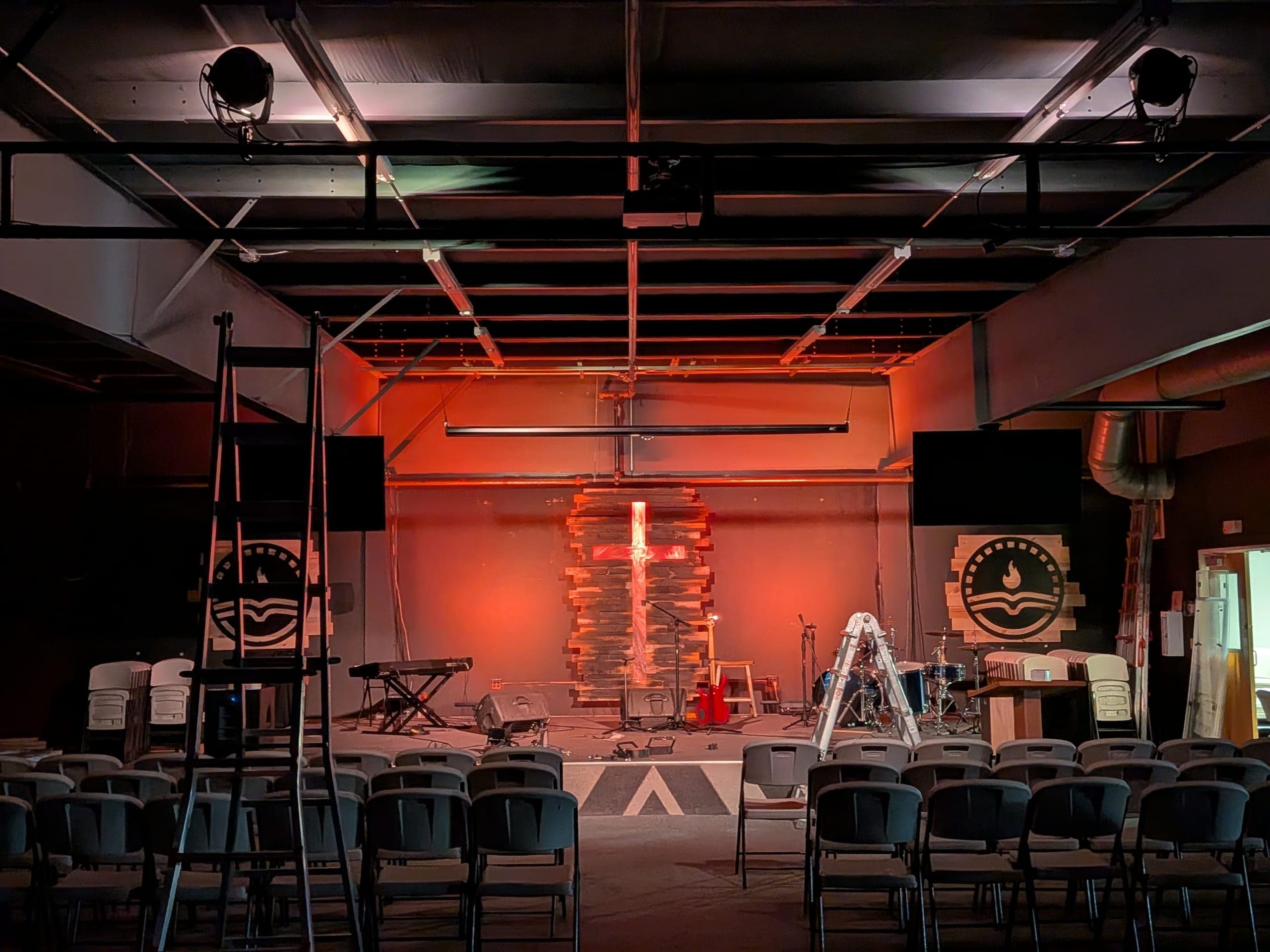
Barn venues photograph beautifully and they are acoustically among the worst rooms anybody gets married in. Both of those things are true at once, and knowing the second one early is what keeps it from being a problem on your wedding day.
What is actually happening
A barn is a large box made of hard parallel surfaces with a high ceiling and almost nothing soft in it. Metal roof, wood or metal walls, concrete or plank floor. Sound leaves the speaker, hits those surfaces, and comes back. Then it hits the opposite surface and comes back again.
What reaches your guests is the direct sound plus a large number of slightly delayed copies of itself. Your ear can handle a little of that. Past a certain point it stops being able to separate the copies from the original, and the result is that everything smears together. Speech gets hard to follow. Music loses its edges. Nobody can tell exactly what is wrong, only that it is unpleasant and they need to talk louder than they want to.
Why turning it up makes it worse
This is the important part. When a room is not intelligible, the instinct is to add volume. In a reflective room that is exactly the wrong move, because you are not just making the direct sound louder. You are making every reflection louder too, in the same proportion.
The signal to noise ratio does not improve. You have simply raised the whole thing, including the part that was causing the problem. Now it is muddy and loud instead of muddy and quiet, guests are shouting over it, and by nine o'clock a third of your reception is standing outside in the cold because it is the only place they can hear each other.
If you have been to a barn wedding where everyone ended up outside, that was not an antisocial crowd. That was a room nobody tuned.
What actually works
The fix is getting more direct sound and fewer reflections to your guests, which is a placement and aiming problem rather than a power problem.
- Get the sources closer to people. Two smaller systems placed near where guests actually are beat one large pair at the end of the room, because the direct sound arrives stronger relative to the reflections.
- Aim tightly. Modern speakers have a defined coverage pattern. Pointed at the dance floor and the tables, most of the energy lands on people. Pointed loosely at the room, most of it lands on walls and comes back at you.
- Angle off the parallel surfaces. Sound bouncing straight back and forth between two parallel walls is the worst case. A few degrees of rotation breaks that up more than people expect.
- Put subwoofers on the floor and out of corners. A corner loads the low end and turns it into a boom that fills the whole building. On the floor near the dance area, it stays where the dancing is.
- Use the crowd. People are excellent absorbers. A full barn sounds dramatically better than the same barn at soundcheck, which is why we tune for the room we expect at nine rather than the empty one at three.
What you can control
Some of this is your decision rather than ours, and it happens before we arrive:
- Where the dance floor goes. Against a long flat wall is the worst spot. Toward an end with some depth or some clutter behind it is better.
- Soft things. Draping, fabric on the ceiling, hay bales, even a lot of people in heavy clothing all absorb sound. Venues that have added draping did it for a reason and it works.
- Seating layout. If dinner tables are spread to the far corners, we are covering a much larger area than if they are grouped. Grouped is better for sound and usually better for the party.
- Whether the doors stay open. An open barn door is a giant hole that dumps your low end into a field. Sometimes that is fine. Sometimes it is why the dance floor feels thin.
Black Hills barns specifically
The barn venues around Piedmont, Hill City, Hermosa, and Custer are a mix of restored wood buildings and newer metal structures, and they behave quite differently. Wood is more forgiving and it also drinks light, which matters for your lighting plan. Metal is brighter acoustically and needs more careful aiming.
Several of these properties also give you an outdoor ceremony and a covered reception, which is the combination that actually survives a Black Hills afternoon. That means two different audio setups on the same day, and they are different problems. The ceremony is usually a placement and wind problem. The reception is this one.
The short version
A barn does not need a bigger system. It needs the system it has pointed at the right things. When we walk your venue before the date, this is most of what we are looking at: where your guests will be, what the walls are made of, where the dance floor sits, and how we get the sound to land on people instead of on the building.